Engineering

Maxwell
The Architecture of Sound
Sound is not magic. It is physics, materials, geometry, and engineering decisions made by people who either care deeply or do not care at all. The ASTRAL-01 exists because we believe those decisions matter — and that they should be visible.
What Most Headphones Get Wrong
Most headphones are designed around a single constraint — cost. Driver size is minimized. Materials are standardized. The internals are hidden because there is nothing worth showing. The result is a product that sounds acceptable and is replaced when it fails, which it always does.
The problem is not the price point. Expensive headphones make the same mistakes. They add complexity without adding honesty. They tune the frequency response to flatter the listener rather than serve the signal. They build in obsolescence through proprietary components that cannot be sourced, replaced, or upgraded.
The Hidden Cost of Disposable Audio
Every pair of headphones that ends up in landfill represents a failure of design intent. The driver that blew. The cable that frayed at the connector. The firmware that was abandoned. These are not accidents — they are the result of design decisions made upstream that prioritized margin over longevity.
What Transparency Actually Means
When we say transparent shell, we mean the outer casing is polycarbonate and you can see through it. But transparency as a design philosophy means something larger. It means showing the work. It means building something that earns the right to be seen.
The Driver Decision
The 50mm planar magnetic driver at the core of the ASTRAL-01 was not chosen for marketing reasons. Planar magnetic drivers work differently from dynamic drivers. Instead of a single voice coil pushing a cone, a planar driver uses a thin diaphragm with a conductive trace distributed across its entire surface. The magnetic field interacts with the entire membrane simultaneously.
Why Planar Matters
The result is lower distortion at high frequencies, faster transient response, and a flatter frequency curve that does not require heavy digital correction. The ASTRAL-01 does not apply EQ by default. What you hear is what the signal contains.
Tuning for Flatness, Not Flattery
Most consumer headphones apply a V-shaped frequency response — boosted bass, boosted highs, recessed midrange. This sounds impressive on first listen and fatiguing over time. The ASTRAL-01 targets a flat response. It is less immediately exciting and more permanently listenable.
The DSP Layer
The onboard DSP chip runs signal processing in real time. Its primary function is environment profiling — analyzing the acoustic signature of the space you are in and applying targeted correction to compensate for external noise without altering the source signal.
What AI-Driven Profiling Actually Does
AI in audio processing is often a marketing term attached to a fixed algorithm. The ASTRAL-01 DSP genuinely adapts. It samples the acoustic environment on initialization and builds a noise profile that updates continuously. It is not canceling noise by inverting a waveform. It is modeling the environment and subtracting it.
The Limits of Digital Correction
We are honest about what DSP cannot do. It cannot fix a poorly recorded track. It cannot compensate for a degraded source signal. It cannot make a bad cable sound like a good one. The ASTRAL-01 DSP is a correction tool, not a rescue tool.
Why the Shell Had to Be Transparent
The transparent polycarbonate shell is not a styling decision. It is an accountability decision. Every component inside the ASTRAL-01 is visible because every component is worth seeing. The PCB trace layout, the driver mounting geometry, the cable routing — these are engineering decisions that we are prepared to defend in full view.
Polycarbonate as a Material Choice
Polycarbonate is aircraft-grade. It is impact-resistant, optically clear, and dimensionally stable across a wide temperature range. It does not yellow with UV exposure at the thickness we use. It is also lighter than aluminum and does not introduce resonance artifacts the way metal housings can.
The Chrome Frame
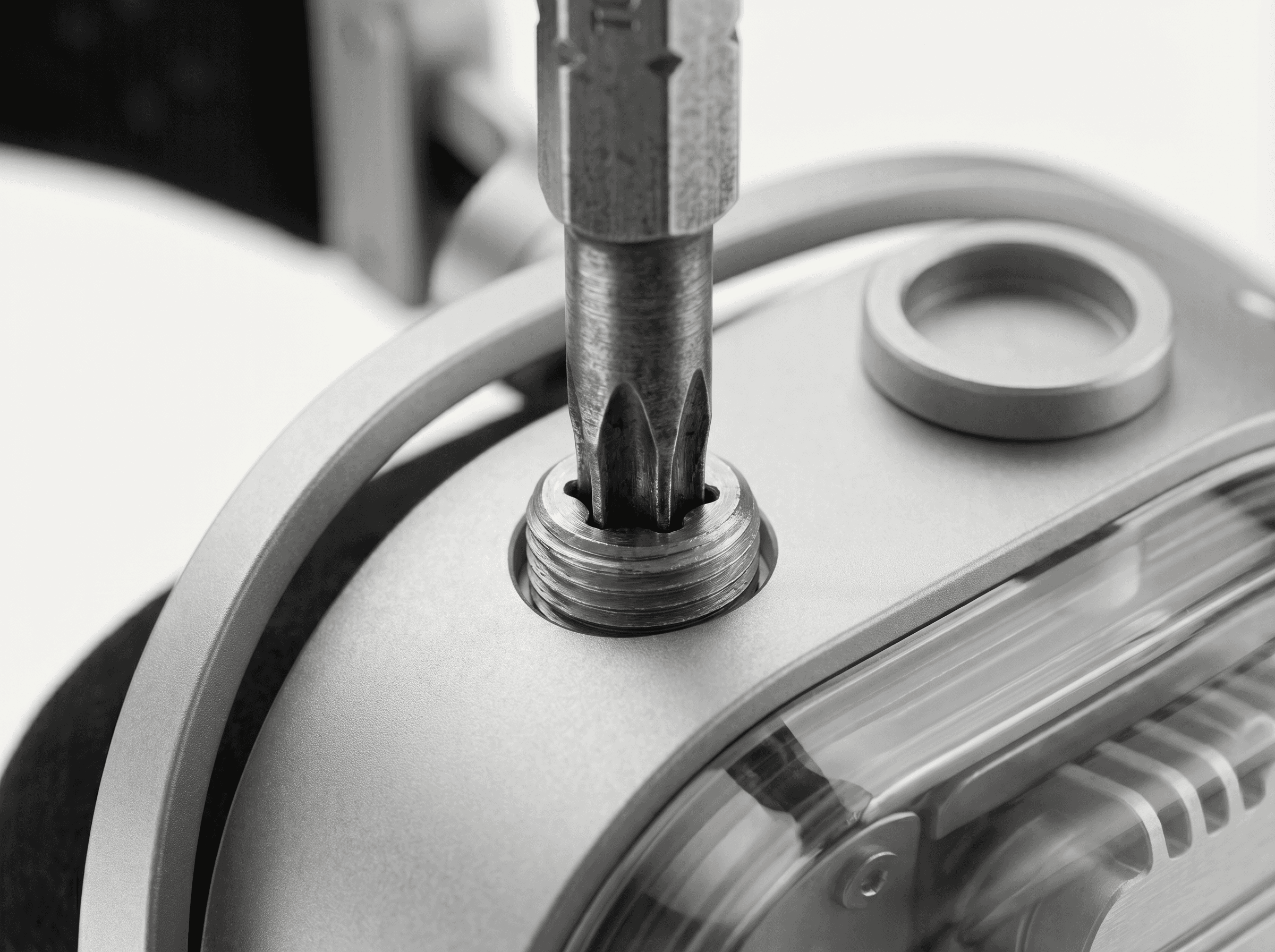
The silver chrome frame that borders the ear cup serves a structural function — it is the mounting surface for the driver array and the cable termination hardware. It also creates the visual boundary between the transparent shell and the ear pad. Everything inside the frame is engineering. Everything outside it is where the listener lives.
What This Means for the Listener
The ASTRAL-01 is not designed to impress in the first thirty seconds. It is designed to still be worth listening to in five years — with the same drivers, a different cable, new ear pads, and firmware that has been updated three times. The architecture of sound is not a single component. It is a system designed to outlast the moment you bought it.
Next in the series — Why Modular Is the Only Honest Design Philosophy.